




 February 5, 2026
Why your numbers don’t line up (and probably never will)
At some point, every marketer hits the same wall.
Google Ads says one thing.
GA4 says another.
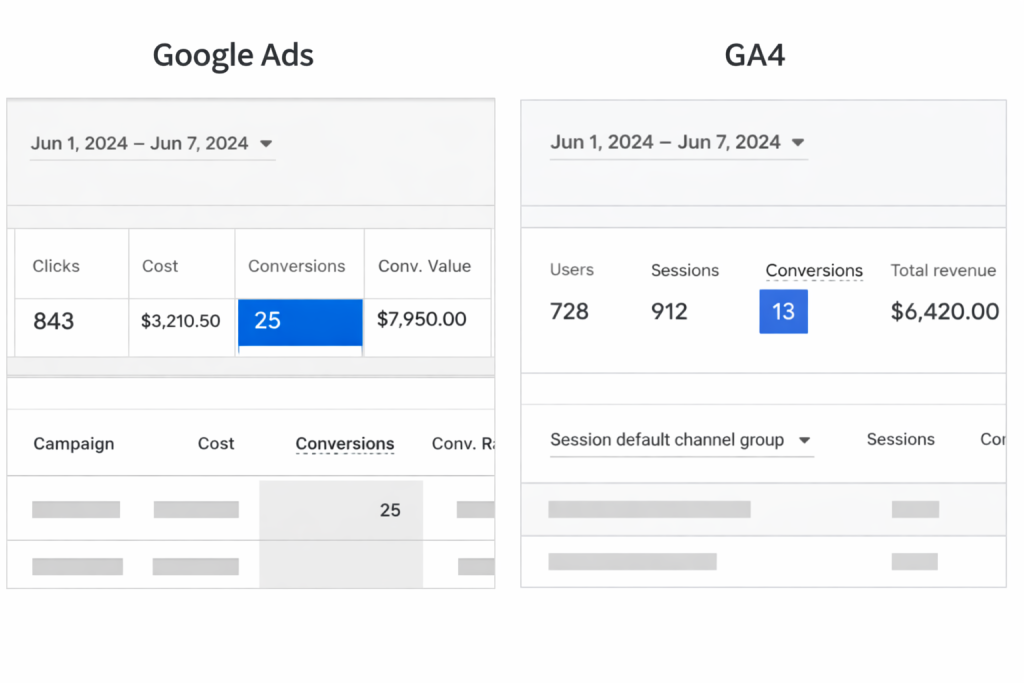
Your CRM says something else entirely.
And the CEO’s spreadsheet? That’s a fourth version of reality. Why’s he tracking data manually? When does he update it!? How!?
You double-check date ranges. You confirm time zones. You toggle attribution models like maybe this one will finally make the numbers agree.
They don’t. And It Ain’t Gonna.
And here’s the uncomfortable truth that took me way too long to accept:
Your numbers aren’t broken. They’re just answering different questions.
Different tools, different jobs, different truths
Most marketing tools are not trying to tell the same story. We just treat them like they should.
- Ad platforms want to show influence.
They’re optimized to answer: “Did this ad play a role at any point?” - Analytics platforms want to show behavior.
They care about sessions, paths, and events — not intent or persuasion. - CRMs want to show revenue.
And even then, only the revenue that made it all the way through your pipeline without falling apart.
None of these systems are lying.
They’re just biased by design.
The mistake is expecting them to reconcile perfectly.
Attribution is not a math problem — it’s a philosophy problem
We talk about attribution like there’s a “correct” answer hiding somewhere if we just pick the right model.
There isn’t.
Every attribution model is an opinion:
- First touch values discovery
- Last touch values conversion
- Data-driven values historical patterns
- Humans value whatever supports the decision they already want to make
Once you see attribution as a lens instead of a verdict, the frustration drops a notch.
The question shifts from:
“Which number is right?”
to:
“What decision is this number trying to help me make?”
Why things got worse (and won’t fully recover)
It’s also fair to say: this problem used to be less bad.
Privacy changes, consent modes, walled gardens, cross-device behavior — all of it chipped away at clean, linear tracking. And none of that is going backwards.
Which means chasing perfect alignment now is usually a waste of energy.
The better move is learning how to:
- Spot directional trends
- Trust ranges, not exact counts
- Combine data with context and judgment
- Decide before looking at the data what “good” actually means
What I trust more than exact numbers
When things don’t line up, I lean on:
- Consistency over time
- Relative performance between channels
- Cost efficiency trends
- What sales and customers are actually saying
- Whether decisions based on the data are improving outcomes
Not because it’s cleaner — but because it’s more honest.


 Prev Post