




 February 12, 2026
Search is changing.
People aren’t just typing keywords anymore.
They’re asking full questions:
- “Who’s the best roofer near me?”
- “Is Invisalign worth it?”
- “Why is my AC blowing hot air?”
- “What’s the safest SUV for a new family?”
And now, instead of ten blue links…
They’re getting answers.
From Google’s AI Overviews.
From ChatGPT.
From Gemini.
From Perplexity.
If your content isn’t structured to answer real questions clearly and confidently… you’re invisible.
This is where AEO (Answer Engine Optimization) comes in.
But here’s the part most marketers miss:
The best AEO strategy doesn’t start with keyword tools.
It starts with customer feedback.
What Is AEO (Quickly, in 2026 Terms)
AEO is about optimizing your content so AI systems can confidently:
- Extract your answer
- Cite your brand
- Recommend your business
- Or summarize your expertise
It’s less about ranking #1.
It’s more about being the trusted answer.
That requires clarity.
That requires authority.
That requires real-world language.
And where does real-world language live?
With your customers.
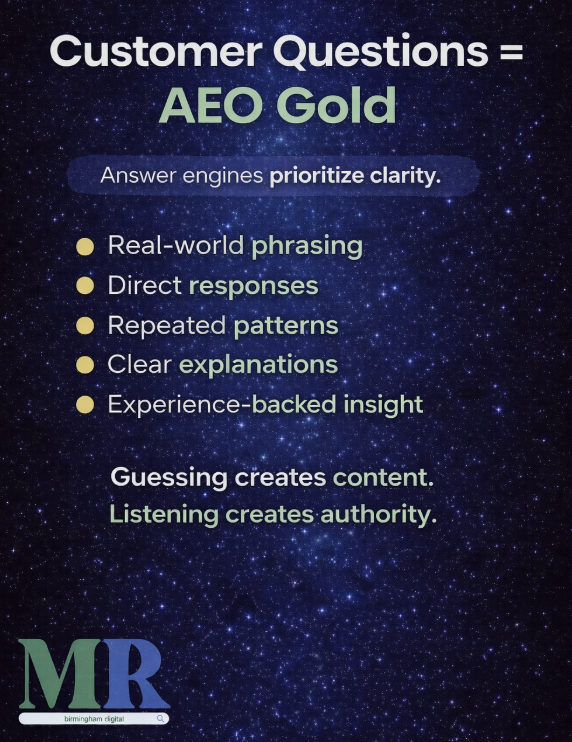
Why Customer Feedback Is AEO Gold
AI systems prioritize:
- Natural language
- Clear answers
- Specific phrasing
- Real-world context
- Experience-backed information
Guess what customer feedback gives you?
Exactly that.
Your customers tell you:
- The exact words they use
- The real problems they’re trying to solve
- The objections they have
- The fears they carry
- The way they describe success
That’s not SEO fluff.
That’s raw intent data.
And AI systems love intent.
Where to Find AEO Fuel in Your Business
Let’s get practical.
Here’s where you should be mining:
1️⃣ Sales Calls
If you’re not recording calls (with proper disclosure), you’re sitting on a goldmine.
Listen for:
- Repeated questions
- Confusion points
- Pricing objections
- “What’s the difference between…” questions
- “Is this worth it?” conversations
Every one of those is AEO content waiting to happen.
Example:
If people constantly ask:
“Why is my AC blowing warm air but the unit is running?”
That’s not just a support issue.
That’s a high-value AEO article.
2️⃣ Customer Reviews
Reviews are incredibly powerful for AEO.
They contain:
- Emotional language
- Outcome language
- Comparison language
- Trust signals
If ten customers mention:
“They showed up on time and explained everything clearly.”
You should have content that answers:
“What should I expect when hiring an HVAC company?”
AI systems look for patterns across sources.
Reviews reinforce your credibility.
3️⃣ Support Emails & FAQs
Support tickets are basically structured search intent.
If customers email:
- “How long does this last?”
- “Do you service Hoover?”
- “What’s included in installation?”
- “Is this covered by insurance?”
Each one of those should be turned into:
- A clear H2 section
- A standalone blog post
- A structured FAQ page
- A short-form explainer video
AEO rewards direct answers.
4️⃣ Lost Deals
This one is underrated.
When someone doesn’t choose you, ask why.
Common answers:
- “Too expensive.”
- “Not sure what’s included.”
- “Another company offered financing.”
- “We weren’t sure if you did X.”
That feedback tells you exactly where your messaging is weak.
And weak messaging means weak AI citations.
How to Turn Feedback Into AEO Content
Now let’s get tactical.
Here’s a simple framework.
Step 1: Extract Real Questions
Create a simple document.
Every week, log:
- 5 most common customer questions
- 3 objections
- 2 misconceptions
Do this for 4 weeks.
You’ll have 40–50 pieces of AEO content fuel.
Step 2: Write Answer-First Content
AEO content should not be fluffy.
Structure it like this:
Question as the header
Example:
Why Is My AC Blowing Warm Air?
Direct answer in 2–3 sentences.
Then expand.
AI systems love:
- Direct definitions
- Clear step-by-step explanations
- Concise summaries
Don’t bury the answer.
Lead with it.
Step 3: Use Customer Language, Not Industry Jargon
If customers say:
“AC blowing hot air”
Don’t write:
“Thermal discharge inefficiency in HVAC compressor cycles.”
Use their words.
AI engines prioritize natural phrasing because they’re trained on natural language.
Step 4: Add Structured FAQs
After your main content, add:
- FAQ sections
- Clear subheadings
- Bullet points
- Concise summaries
Structure matters.
AI models extract cleanly formatted content more confidently.
Step 5: Reinforce With Experience Signals
This is big.
Don’t just answer.
Anchor your answers in experience.
Example:
“In our 15+ years servicing homes in Birmingham, the most common cause of AC units blowing warm air is a refrigerant issue or a frozen evaporator coil.”
That’s real.
That builds trust.
And trust increases the likelihood of citation.
Why This Matters More in AI Search
Traditional SEO was about:
- Backlinks
- Keywords
- Technical optimization
AEO is about:
- Clarity
- Authority
- Relevance
- Structured answers
- Real expertise
Customer feedback gives you the raw material to build all of that.
Without it, you’re guessing at what people care about.
With it, you’re aligning directly with real human intent.
What Happens If You Don’t Do This
If you ignore customer feedback:
- Your content becomes generic
- Your answers lack specificity
- AI systems summarize competitors instead
- You lose visibility in AI Overviews
- You lose citations in tools like ChatGPT
In AI-driven search, vague content disappears.
Clear, experience-backed content wins.
A Simple Weekly AEO Habit
Here’s a practical suggestion.
Every Friday:
- Review:
- Sales calls
- New reviews
- Support emails
- Pull 3 real questions
- Create 1 short answer post
- Publish consistently
Do that for 90 days.
You won’t just improve SEO.
You’ll train answer engines to recognize your brand as a source.
The Bigger Picture
AEO is not about gaming AI.
It’s about becoming the most helpful answer.
Customer feedback tells you:
- What people are confused about
- What they fear
- What they value
- What they compare
- What they don’t understand
If you answer those things clearly, repeatedly, and structurally…
AI systems notice.
And when AI systems notice, your brand becomes part of the conversation — even when people never click a link.
That’s the future of search.
And it starts with listening.


 Prev Post