



 June 30, 2026
If you’re old enough to remember LimeWire, you remember the feeling. You could type in any song, any album, any obscure B-side, and it was just there. Free. Instant. A little lawless. Half the files were mislabeled and a quarter of them gave your computer a virus, but it didn’t matter — the dam had broken and music was suddenly infinite.
That’s where we are with AI right now. And if the history of music tells us anything, the part everyone’s enjoying is not the part that lasts.
What actually happened to music
Here’s the thing most people get wrong when they tell this story: music never became free.
Napster made it feel free, the same way AI feels free right now. But what actually happened over the next twenty years wasn’t free music — it was a quiet, total shift from owning music to renting access to it. You don’t own your Spotify library. You pay around twelve dollars a month, or you pay with your attention and a stream of ads, and the moment you stop paying, the catalog disappears. The MP3 you “owned” became a stream you borrow.
The industry didn’t beat piracy by stopping it. They beat it by re-manufacturing scarcity around something piracy couldn’t touch: convenience, reliability, and access to everything in one place. iTunes made buying easier than stealing. Spotify made renting easier than owning. The product stopped being the song and became the system.
And the people who made the music? Recorded music stopped being where the money was. The value didn’t disappear — it relocated. To touring. To merch. To brand. To becoming a personality people would follow and pay to be near. The artist became an influencer out of necessity, because the thing they actually made had been turned into a commodity sold by the platform, not by them.
Hold onto that, because it’s the whole point.
The three eras, mapped onto AI
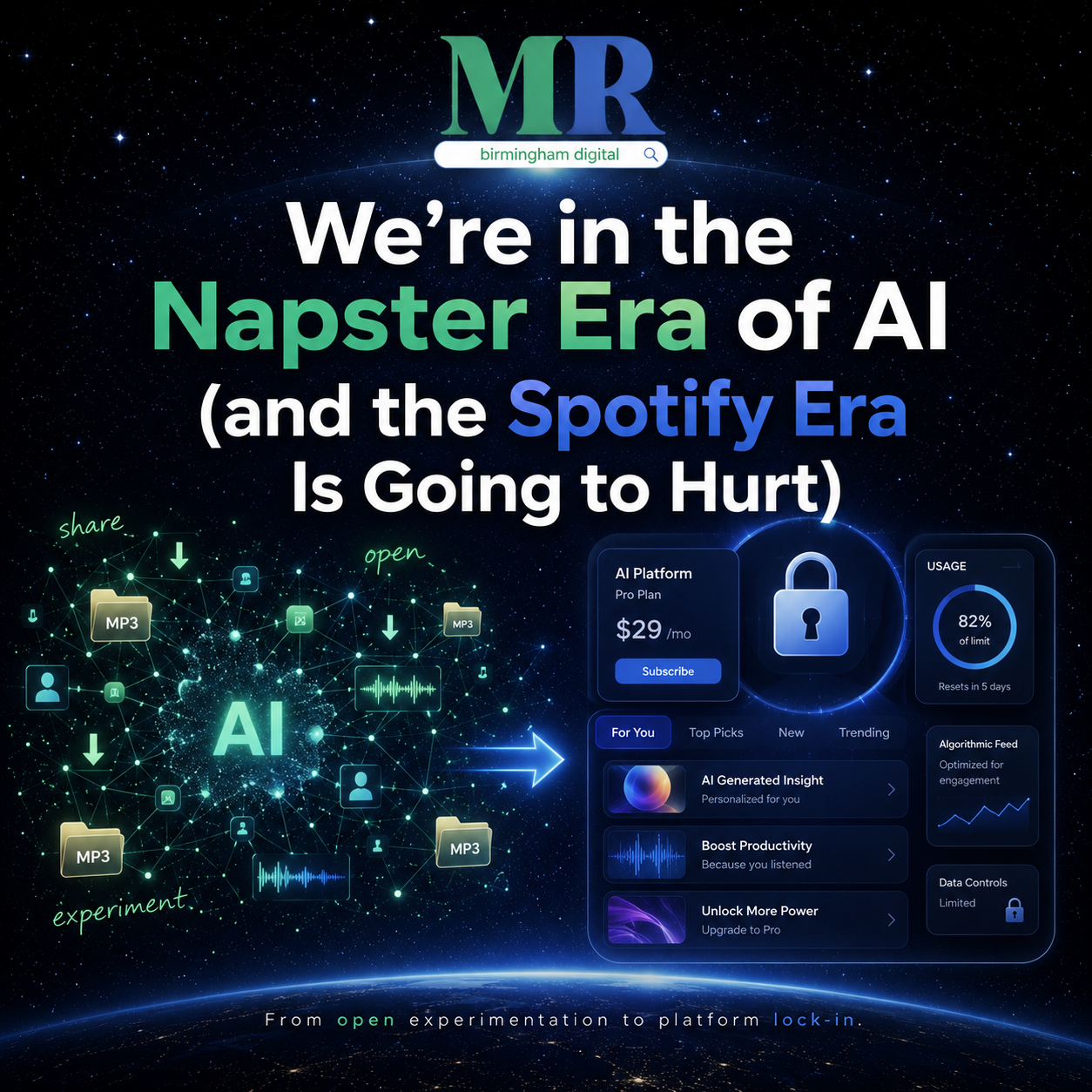
The Napster era (right now). Subsidized abundance. Anyone can generate infinite copy, images, strategy, ad variations — and it feels close to free even though we’re all quietly paying twenty bucks a month for the privilege. It’s lawless and a little chaotic, and the market is flooded. Just like a folder full of mislabeled MP3s, the flood is quietly destroying the perceived value of the thing itself. When everyone can produce a blog post in nine seconds, a blog post is worth nothing.
And here’s the tell that we’re still early: most “AI products” today aren’t products at all. They’re a search box over a shared pool — a thin layer of UX wrapped around someone else’s model. That’s not iTunes. That’s the LimeWire-era download site. There’s no defensible scarcity in a wrapper, because anyone can build the same box over the same commons. The convenience layer that actually captures value hasn’t really arrived yet.
The iTunes era (barely starting). This is where someone packages the chaos into something convenient and trustworthy enough that people pay for the curation rather than the raw tool. You stop paying for access to the model and start paying for the thing built thoughtfully on top of it — the version that just works, that you trust, that saves you from the flood. We’re only seeing the first flickers of this.
The Spotify era (coming, and this is the one that hurts). Access becomes the product. And two things happen at once that almost nobody is pricing in.
The plot twist: human brute force comes back
Everyone assumes AI just gets cheaper forever. Inference costs have been falling, so the story writes itself: infinite intelligence, approaching free, forever.
I don’t think that’s how it plays out, for two reasons.
First, the subsidy ends. The price you pay for tokens today is not the real price of the intelligence. It’s venture money buying market share, sold below cost to get you hooked — the same way Spotify ran at a loss for years and Uber rides were mysteriously cheap right up until they weren’t. The all-you-can-eat buffet is a customer-acquisition strategy, not an economic reality. When the capital stops flooding in and these companies need actual margins, the true cost of cognition shows up on your bill.
Second, usage scales faster than prices fall. Even as the cost per token drops, the way we use AI is exploding in the other direction. A task that used to be one prompt now spawns an agent that burns through thousands of reasoning steps to get there. The unit price goes down while the total bill goes up.
Put those two together and you get something genuinely strange: a real, metered, per-unit cost on thinking — a cost that didn’t exist during the free-for-all. And for a whole category of work, the math quietly flips back. Burning a small fortune in tokens to brute-force a task stops making sense when a human can just do the thing for less.
Human brute force comes back into the workforce — not out of nostalgia, not because the human is better, but because the human got cheaper than the robot again. It’s arithmetic, not sentiment.
So what does this mean for marketing?
This is where it stops being a tech-history essay and starts being a survival plan.
If AI commoditizes execution, then doing the work stops being where the money is — exactly like recorded music stopped being where music money is. The marketer who automated everything isn’t the winner in that world. They’ve just turned their craft into a stream the platform sells.
The winners are the ones who figure out the marketing equivalent of merch and touring — the scarce things AI can’t flatten into a commodity:
- Trust and reputation. When content is infinite and free, being a known, trusted source is the only thing that’s scarce. This is exactly why AI search rewards entity authority over keyword stuffing — it’s not about who produces the most words, it’s about who the machine and the market already know to trust. The musician sells merch because the music is free. The marketer sells trust because the content is free.
- Judgment about where to spend. In the metered-token future, the edge isn’t running AI on everything — it’s knowing which tasks are worth expensive intelligence and which are cheaper done by a person with taste. AI becomes a premium instrument you deploy on purpose, not a firehose you leave running in the corner.
- Proprietary data and real relationships. The model can’t scrape what only you have: your customers, your numbers, your actual conversations.
- The human brand behind the work. Same move the musicians made. The person becomes the moat.
The takeaway
We’re in the Napster era, and it’s a great party. Everything’s abundant, everything’s cheap, and the old rules feel suspended.
But the Napster era was never a bubble — the demand for music was completely real. What collapsed wasn’t music. It was the business model, and the value violently relocated to the things the platform couldn’t commoditize.
AI is the same. The demand is real. The abundance is temporary. And the Spotify era — metered, margined, with the subsidy gone and humans pulled back into the loop for everything that isn’t worth the tokens — is coming whether we’re ready or not.
The smart move is the one the artists who survived made early: stop competing on the thing that’s about to become free. Start building the scarce thing now — the trust, the judgment, the brand, the relationships — while everyone else is still downloading MP3s like the music will be free forever.
It won’t be.


 Prev Post
What do you think?
Show comments / Leave a comment